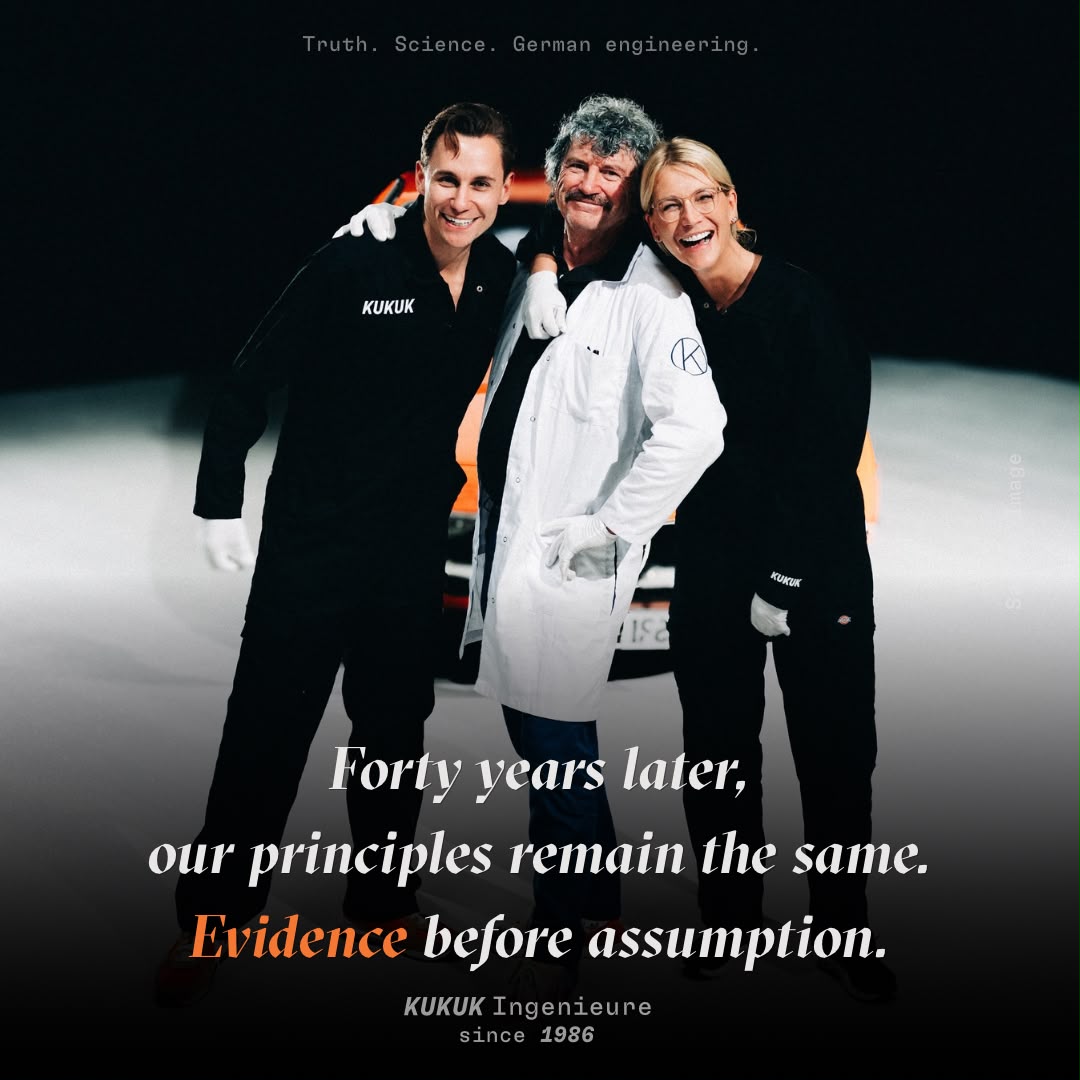
Forty years in business is a meaningful milestone. Not because of the number alone, but because of what it stands for: decades of technical questions, vehicle investigations, documentation and decisions where clarity mattered.
Since 1986, the collector-car world has changed profoundly. Vehicles have become more complex. Restoration standards have evolved. Expectations around documentation, provenance, insurance and traceability have risen. At the same time, scientific methods and digital tools now open possibilities that were unthinkable four decades ago.
Yet the core of good engineering has remained the same: ask carefully, observe precisely, document clearly and conclude responsibly. That attitude still shapes KUKUK Ingenieure today.
Confidence is not built on assumptions. It is built on evidence.
A look back. A look forward.
This anniversary is not a closing statement. It is a moment to pause. What has carried KUKUK since its foundation? What remains relevant when markets, technologies and vehicles change? And what responsibility does that create for the next generation?
The answer is not one method and not one report. It is our way of working. We do not look at a vehicle only as an object with a market value. We read it as a technical, historical and documentary whole. Condition, originality, history, material, repairs, restorations, measurements, photographs and records belong together for us.
For collector vehicles, that connection is decisive. A beautiful surface can hide unanswered questions. An extraordinary story can remain uncertain without evidence. An old document can be valuable, but it must still fit the vehicle itself. That is why every reliable investigation begins with five principles.
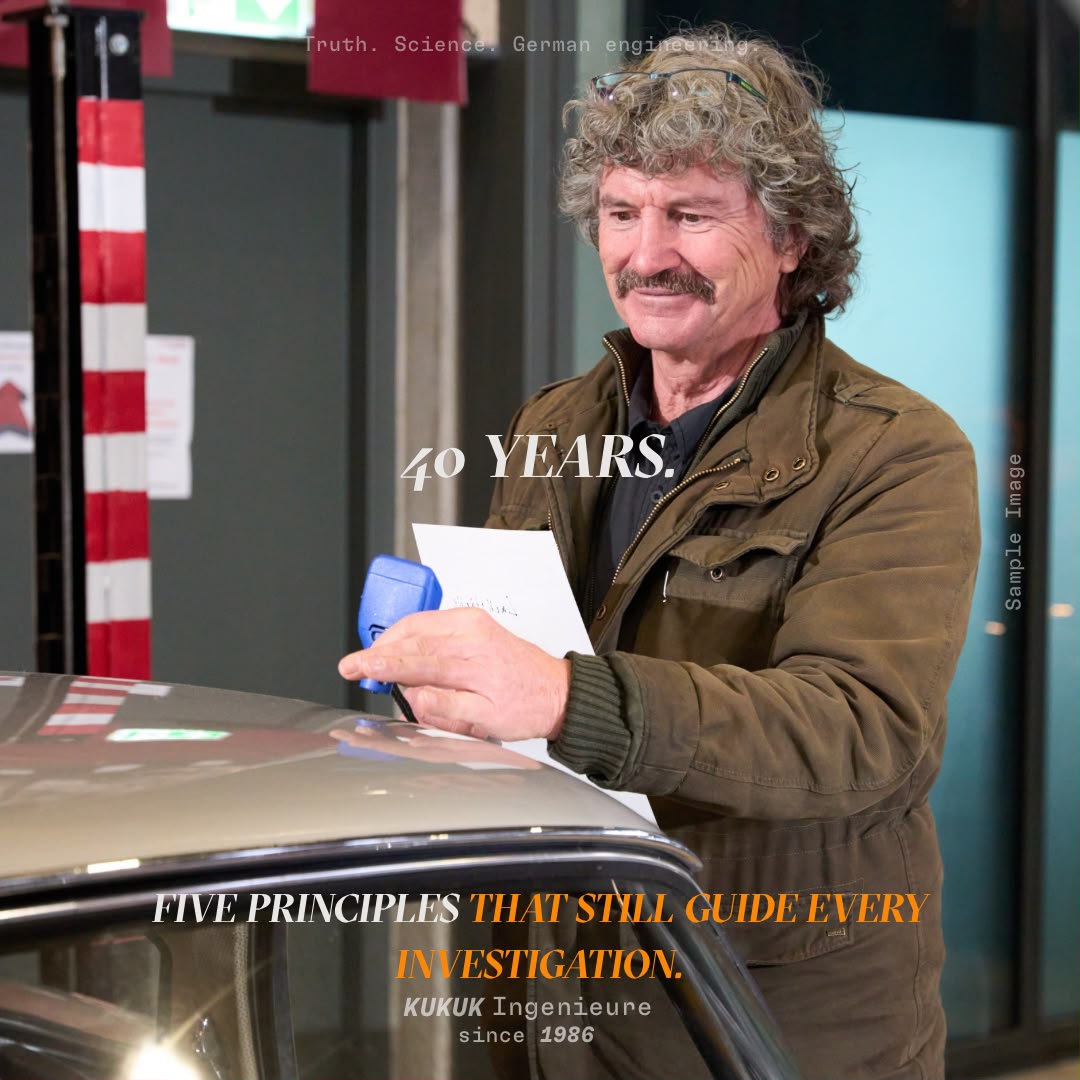
1. Curiosity comes before conclusions
Every investigation begins with a question. Not with an assumption. Whether the task is originality assessment, documentation analysis, vehicle appraisal, damage investigation or Pre Purchase Inspection, the objective is never to confirm expectations. The objective is to understand the facts.
Good engineering therefore starts with curiosity. Which traces are visible? Which documents are missing? Which details contradict the narrative? Which findings explain a component, a paint layer, a repair or a historical deviation? The right questions often reveal what is not visible at first glance.
This attitude matters to buyers, sellers, collectors, insurers, auction houses and institutions alike. It protects against premature conclusions and creates a basis for decisions that remain understandable later.
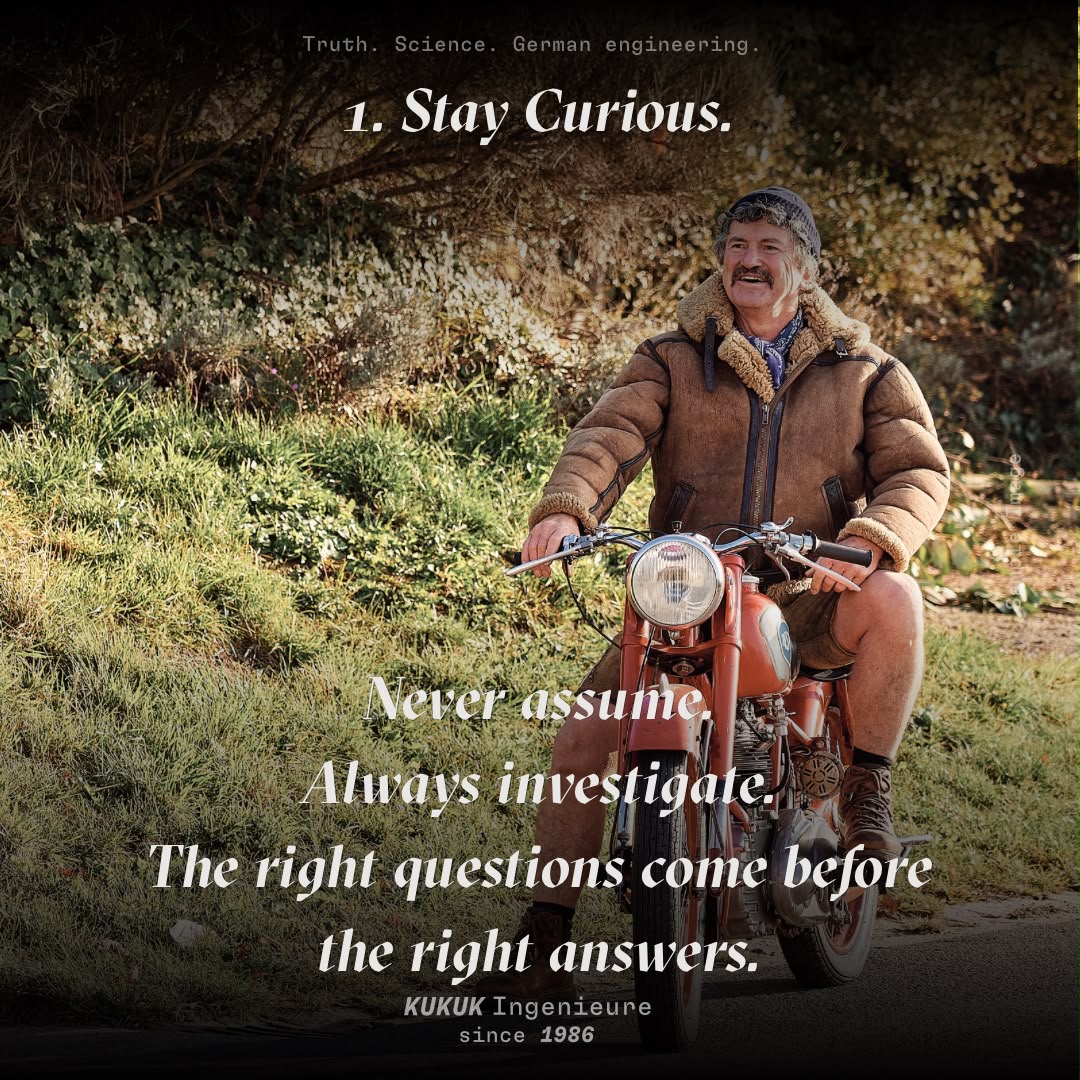
2. Evidence is more valuable than assumptions
Collector vehicles often carry remarkable stories. Some are fully documented. Others rely on memory, tradition, reputation or long-held assumptions. The role of independent engineering is to distinguish between what can be demonstrated and what must remain open.
Condition, originality, damage history, restoration scope, technical findings and documentation should not be read in isolation. An invoice can prove that work was paid for, but not automatically that the work was technically correct. A photograph can show a condition, but without context it may not explain enough. A market price can offer orientation, but it cannot replace the technical truth of the individual vehicle.
Every conclusion should therefore be supported by evidence. Evidence creates clarity. Assumptions create uncertainty. In a collector market driven by enthusiasm and passion, that difference is not academic. It affects purchase decisions, insured values, restoration strategies, succession planning and the long-term history of a vehicle.
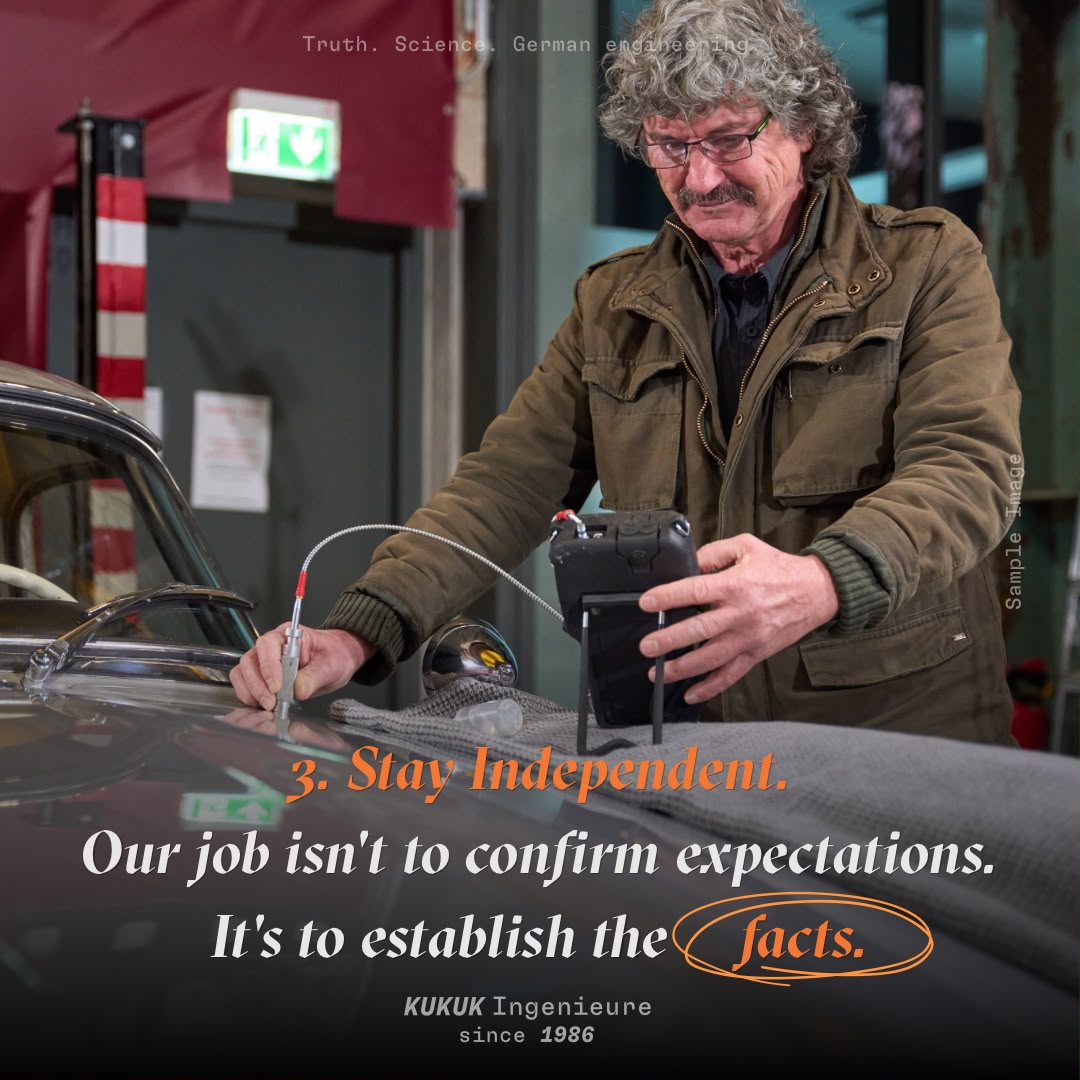
3. Independence builds trust
Objectivity is one of the most valuable qualities a technical assessment can offer. Independent engineering helps stakeholders make decisions on a reliable basis. The point is not to satisfy expectations. The point is to evaluate technical facts in a traceable way.
This independence is especially important where emotional and financial values meet. A collector wants confidence. A buyer wants to understand risk. A seller wants transparency. An insurer needs a professional basis. A court or institution needs arguments that can be followed.
The result of an investigation does not need to be loud. It needs to be traceable. It should explain which facts are reliable, which questions remain open and what those findings may mean.
4. Every detail matters
In collector vehicles, the smallest details often carry the greatest significance. An original component. A documented repair. A production detail. A missing invoice. A historical photograph. A weld, a paint structure, a stamp, a material change or an entry in an archive file.
Individually, these pieces of information may seem small. Together, they tell the story of a vehicle. Understanding that story requires patience, precision and experience. That is the difference between a surface-level impression and a reliable analysis.
Detail work also shows respect for the object. A historic vehicle is not only a market item. It is a piece of technical culture that must be understood across years, owners, workshops and decisions.

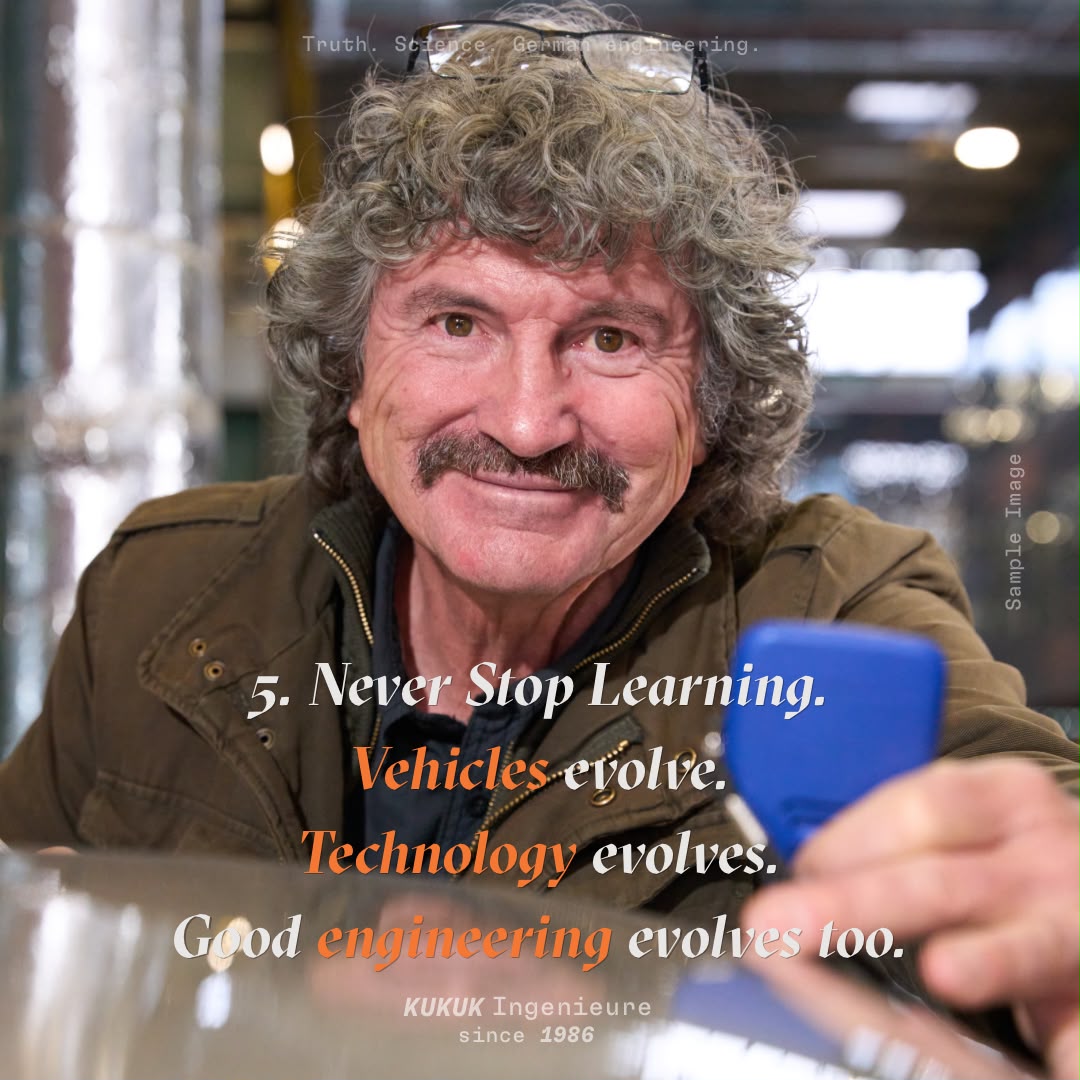
5. Learning never stops
The vehicles inspected today are fundamentally different from those inspected forty years ago. Mechanics are complemented by electronics. Software influences function. Control units, sensors, driver assistance systems, digital documents and complex materials are now part of many modern collector vehicles.
Technical assessment methods must evolve with that reality. New technologies change the tools. They do not change the responsibility. Anyone who evaluates vehicles professionally must be willing to question methods, advance scientific procedures and take technical change seriously.
This willingness to learn connects the founding generation with the next generation. It makes KUKUK not only a keeper of experience, but a company that connects experience with new methods, digital documentation and scientific curiosity.
Thank you, Klaus Kukuk
This anniversary is also an opportunity to recognise Klaus Kukuk. His curiosity, technical understanding and independent way of thinking laid the foundation for the company in 1986.
His passion for engineering has always been connected with the desire to keep developing, to understand new technologies and to advance scientific methods. That attitude still shapes KUKUK today. It inspires the next generation to approach old and new paths with openness, responsibility and technical care.
Forty years are therefore not a conclusion. They are an opportunity to pause, reflect and open the next chapter.
What this anniversary means for collectors
The collector market is driven by enthusiasm and passion. That is what makes it alive. For us, that passion also carries responsibility: the future of the collector market will not be shaped only by emotion, beauty and rarity, but increasingly by transparency, documentation, traceability and technical integrity.
Anyone who wants to buy, sell, insure, restore, inherit or document a vehicle over time needs more than an opinion. They need a reliable basis. That is where independent engineering remains relevant: it connects technical findings with documents, experience with method, and passion with responsibility.
We will continue to evolve. The tools will change. Vehicles will become more complex. Digital dossiers, scientific analysis and more precise documentation processes will become more important. Yet the principles that have guided every investigation since 1986 remain unchanged.
Search and advertising compliant context
This article describes the history, attitude and working principles of KUKUK Ingenieure. It does not guarantee specific vehicle values, promise appreciation or provide investment advice. Technical assessments, appraisals and Pre Purchase Inspections always depend on the individual vehicle, the available records, the scope of work and the date of assessment.
That clarity is part of the method. Serious communication can create interest without promising outcomes that can only be assessed after a professional investigation.
FAQ about 40 years of KUKUK Ingenieure
When was KUKUK Ingenieure founded?
KUKUK Ingenieure was founded by Klaus Kukuk in 1986. Since then, the company has worked in independent vehicle analysis, technical documentation, appraisals, authentication, damage assessment and Pre Purchase Inspection.
Which principles guide KUKUK's work?
The work is shaped by curiosity, evidence, independence, attention to detail and continuous learning. The goal is a traceable technical basis rather than the simple confirmation of expectations.
Why is evidence so important for collector vehicles?
Because condition, originality, history and documentation can influence value and decision-making. Evidence helps distinguish plausible facts from unsupported assumptions.
Can we guarantee a specific market value?
No. We provide professional assessments based on available findings, documentation and market data at the relevant point in time. There is no guarantee of sale prices or future value development.
Conclusion
Forty years of KUKUK Ingenieure stand for more than experience. They stand for an attitude: ask first, investigate carefully, document clearly, then conclude. That sequence is slow enough to be precise and strong enough to support important decisions.
The vehicles will continue to evolve. The technologies will continue to evolve. We will evolve too. But one principle remains: confidence is not built on assumptions. It is built on evidence.