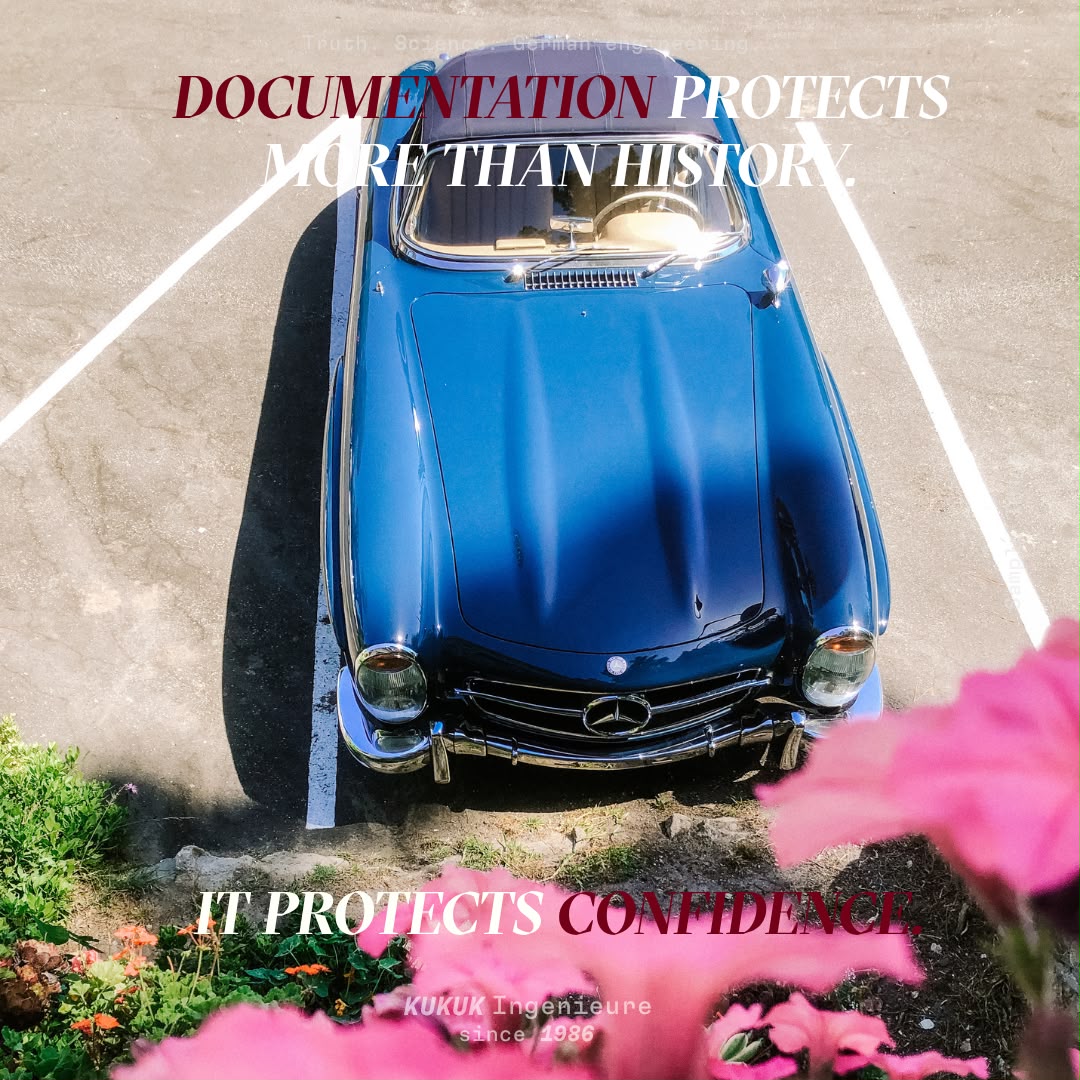
The current debate around future requirements for historic and collector vehicles points to something serious collectors already understand. A classic car's value is not held only in metal, leather, engine numbers and patina. It also depends on whether that substance can be explained.
What was restored, and when? Which components remain original? Which interventions are documented? Which appraisals, photographs, invoices, laboratory findings or technical reports support the story? And which parts of that story exist only in the memory of a previous owner?
That is where professional classic car documentation begins. It is not administrative housekeeping. It is the trust architecture of a collector vehicle.
The real question is not only: what might change?
Regulatory conversations tend to create anxiety because they sound like future obligations, restrictions or exemptions. For collectors, another question is often more useful: what remains important regardless of the final legal shape?
The answer is traceability. Across Europe, the conversation around product transparency, circularity, ecodesign and Digital Product Passports points in one direction: reliable product information is becoming more important. It would be wrong to claim that every classic car is automatically subject to one specific future passport requirement. But the market signal is clear. Buyers, insurers, institutions, banks and regulators are asking for better evidence.
This is not foreign to the collector-car world. The best collectors have always asked whether a car merely tells a beautiful story, or whether that story can withstand scrutiny.
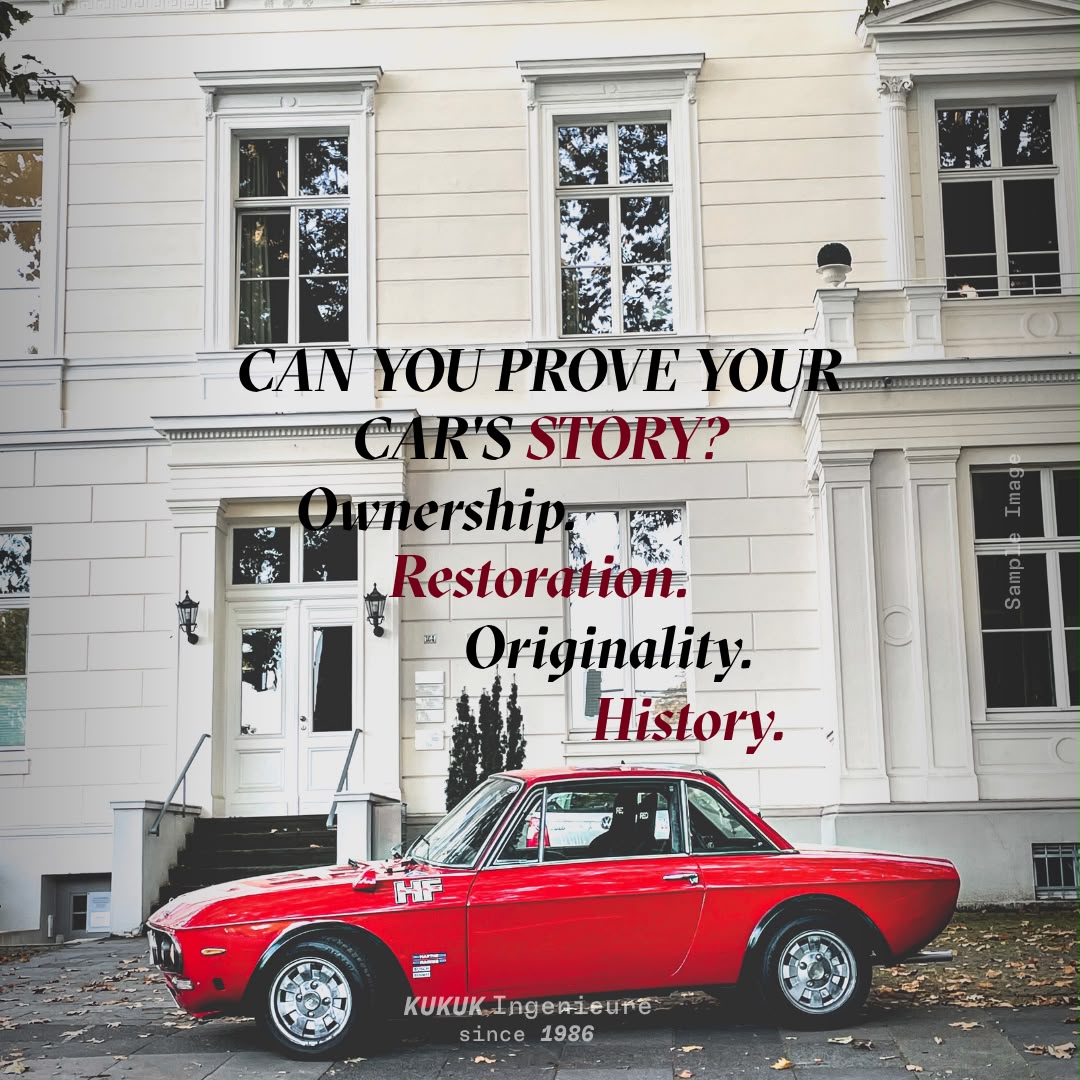
For important vehicles, trust is not declared. It is documented.
Why documentation gains value with every ownership change
A collector car is never truly static. It is driven, stored, maintained, transported, inspected, repaired, restored, sold, inherited and sometimes reinterpreted. Each event creates information. At the same time, each event creates the risk that context will be lost.
An invoice proves that work was paid for, but not necessarily what the work means technically. A photograph shows a condition, but without date, angle and assembly context it may not explain enough. An appraisal is valuable, but it captures a moment. The real strength appears when these pieces are connected over time.
That is why documentation becomes more important as a car ages. The more layers a vehicle carries, the more it needs a coherent chronology: first delivery, ownership chain, restoration work, paint structure, material findings, repairs, maintenance, damage events, transport incidents, valuation moments and use history.
What a reliable vehicle dossier should do today
A modern vehicle dossier must do more than store documents. It must explain relevance and connect the right evidence. For collectors, buyers, insurers, lenders, museums and heirs, it should turn scattered information into answers that can be checked and shared.
- Identity: chassis number, engine, gearbox, body, stamps, plates and allocation.
- Originality: original substance, later additions, period-correct changes and unclear areas.
- History: ownership chain, use, delivery records, archive material and provenance sources.
- Condition: technical findings, body, paint, interior, mechanics and safety-relevant issues.
- Restoration: scope, quality, materials, workshop records and before-and-after evidence.
- Damage: events, repairs, diminished value, consequential risks and evidence preservation.
- Care: maintenance, roadworthiness inspections, insurance confirmations and deadlines.
This is useful long before a sale. It supports collection management: which car needs service, which insured value should be reviewed, which documents are missing before a concours, an auction or a succession process?
Where traditional documentation reaches its limits
Many collectors keep remarkable paper files. Those files often prove care and seriousness. Yet paper binders, loose PDFs, workshop images, message threads, old reports and archive scans do not automatically become a reliable structure.
The problem is not lack of information. The problem is legibility. If a buyer, insurer or expert first has to decode which document belongs to which event, friction appears. If translations are missing, an international car becomes harder to explain. If ownership periods, family history or restoration phases are not separated cleanly, an important value argument can be weakened.
A digital vehicle record does not solve this by upload alone. It must be curated. It must connect technical findings, images, documents and narrative history in a way that still makes sense ten or twenty years from now.
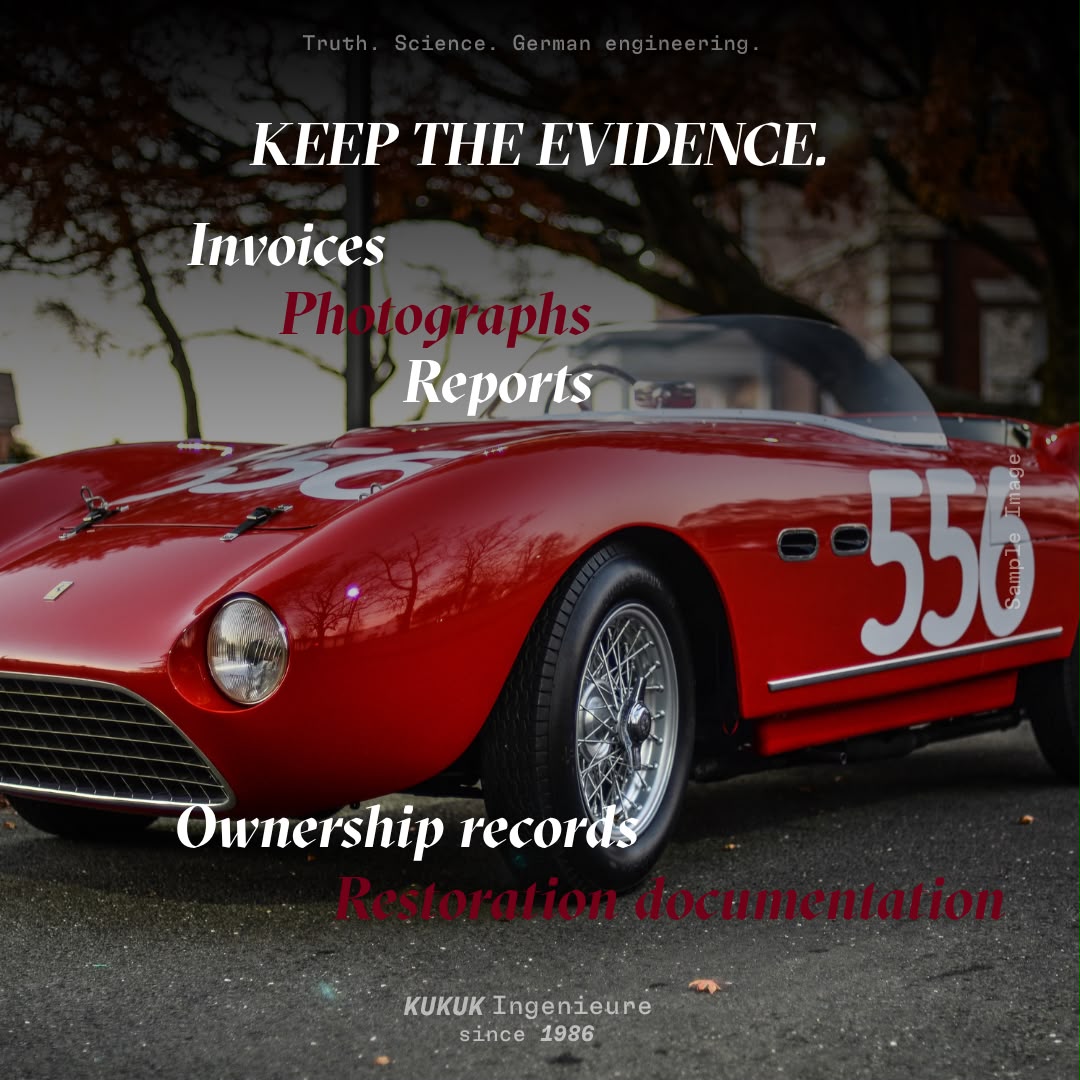
KAR: KUKUK Signature as a forensic truth layer
This is where KAR, KUKUK Signature, becomes relevant. The ambition is not another attractive database for collectors. The ambition is a verifiable link between object, finding, story and digital identity.
KUKUK comes from more than four decades of independent engineering and expert witness work. That matters. In the collector market, opinion is not always enough. For significant cars, prototypes, one-offs or value-critical restorations, there must be a layer that brings material, substance, measurement, experience and documentation together.
KUKUK Signature translates that ambition into a living vehicle dossier. The Molecular Signature captures the material level: paint layers, material structure, repair traces, ageing, original and later substance. The Signature Twin makes those findings understandable in a digital environment. The Hallmark connects the physical object with its digital dossier.
The point is not technology for its own sake. The point is a sentence that will matter more and more to collectors, brands and institutions: this vehicle can substantiate its own story.
Why KUKUK Signature goes beyond classic provenance
Provenance is often understood as origin. That is true, but too narrow. For collector vehicles, provenance also includes the technical truth of the object. A car can have a remarkable ownership story and still leave technical questions unanswered. Another car can be technically excellent but historically underdocumented.
KUKUK Signature brings both layers together. The emotional story remains important: journeys, races, family ownership, restoration decisions, memories. But it is not used as a substitute for technical evidence. It stands alongside paint findings, material analysis, 3D documentation, expert reports, photographs and maintenance events.
This creates a new kind of documentation: not a one-off certificate, but a growing dossier. Every relevant inspection, condition change, restoration and ownership transfer can add a new layer.
What collectors can do now
Owners of important cars do not need to wait for future rules, future platforms or future market standards to be finalised. The most valuable work can begin immediately.
- Gather all existing material and organise it by event rather than by file type.
- Identify missing basics: identity, numbers, reports, images, invoices and ownership history.
- Separate restoration phases and repair phases clearly.
- Update technical findings if the last inspection is too old.
- Document damage, transport events and material interventions separately.
- Prepare concise multilingual summaries for international buyers, insurers or institutions.
- Actively monitor roadworthiness inspections, maintenance, insurance confirmations and coverage extensions.
The starting condition is especially important. What is documented today creates comparability tomorrow. That applies to restorations, inheritance, insurance claims, sales and concours preparation alike.
Why this matters before a purchase
In a collector-car purchase, documentation is not a formality. It is part of the inspection. A Pre Purchase Inspection does not merely ask whether a car looks convincing. It checks whether condition, identity, history and price form a coherent picture.
In high-value cars, the most expensive risks often live where story and substance do not match: unexplained paint structure, an unclear engine change, an old damage trace, a restoration without records or an offer that claims more than it documents.
The best time to create clarity is before the decision. After the purchase, an open question quickly becomes an ownership problem.
FAQ
Do classic cars now need a Digital Product Passport?
Not as a blanket statement. The broader European direction is toward more transparency and traceability. For collector cars, the practical lesson is that reliable evidence of identity, history, condition and work carried out is becoming more valuable.
Does KUKUK Signature replace a professional appraisal?
No. A professional appraisal remains an important expert layer. KUKUK Signature extends the logic by connecting findings, material evidence, documentation, digital identity and ongoing history in one living dossier.
Is structured documentation only useful for million-euro cars?
No. Whenever originality, condition, insurance, succession or future sale matters, documentation matters. The difference is the depth of the dossier, not the principle.
Conclusion
Regulations may change. Markets may move. Expectations may rise. The importance of reliable documentation remains.
Collector cars are never only about ownership. They are about preserving a story in a form that can be understood, challenged and passed on. That is where the future of collecting begins: not with more claims, but with more truth.