Evidence before impression. Substance before narrative.
The following content shows how KUKUK combines technical observation, documentation and experience to make important vehicle decisions more resilient.
Case requestInsurance, Liability and the Details Between
At first glance, the transport or handling of a vehicle seems relatively uncomplicated. A dealer will arrange the sale, a workshop may undertake an inspection, and a transport company will pick up the vehicle and deliver it.
In reality, however, this process often involves several parties and just as many insurance companies.
If damage occurs, a central question quickly arises
Which insurance is actually responsible?
Depending on where and how the damage occurs, different liability systems can apply. In addition to the actual repair costs, other claims may arise, for example:
Costs of an expert report
Use loss compensation
A possible depreciation of the vehicle
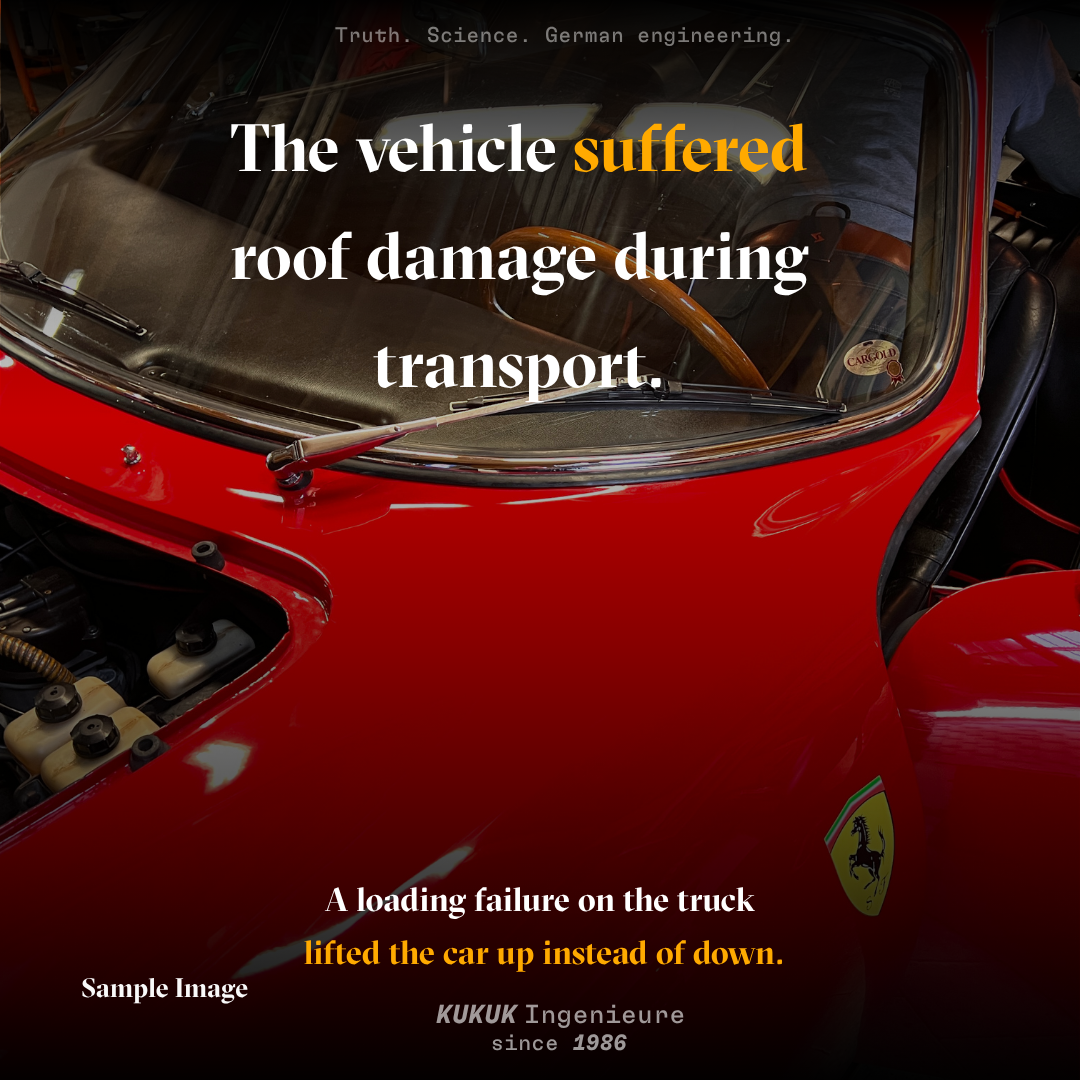
A high-quality vehicle is to be delivered by a dealer to his new owner. The dealer commissions a transport company to pick up the vehicle.
When unloaded, the roof of the vehicle is damaged.
At first glance, the case seems clear
The damage occurred during transport.
On closer inspection, however, it appears that the transport company subcontracted the contract to another company whose insurance cover did not correspond to the actual value of the vehicle.
The damage itself occurs in a few seconds.
The process of clarifying it begins afterwards.
What insurance may be responsible
KFZ Liability Insurance
It is effective when damage is caused by the operation of a vehicle, for example when maneuvering or during a test drive.
Typically, it covers
Potential impairment
Repair costs
Expert costs
Loss of use
Transport or carrier liability insurance
This insurance applies to damages incurred between the acceptance and delivery of the transported goods.
In road transport, legal liability is often limited to
8,33 Special Drawing Rights (SDR) per kilogram of freight weight.
For high value vehicles, this legal liability limit can be significantly lower than the actual value of the vehicle.
Occupational liability insurance
This insurance covers damages incurred in the normal course of business.
These include, for example,
shunting of a customer vehicle
Working in the workshop
Loading and unloading
However, many policies include compensation limits for customer vehicles.
Frequently overlooked damage components
The financial damage rarely ends with the repair bill.
Impairment
Even after a professional repair, a vehicle can lose market value because it is now considered an accident vehicle.
An independent car expert determines:
Repair costs
Repair time
Potential impairment
Loss of use
If the vehicle cannot be used during repair, loss of use compensation may arise.
Legal expenses
If the injured party did not cause the damage himself, the costs of legal enforcement of the claims can often be covered by the opposing insurance company.
Why Documentation is Crucial
For collector vehicles, a simple principle applies
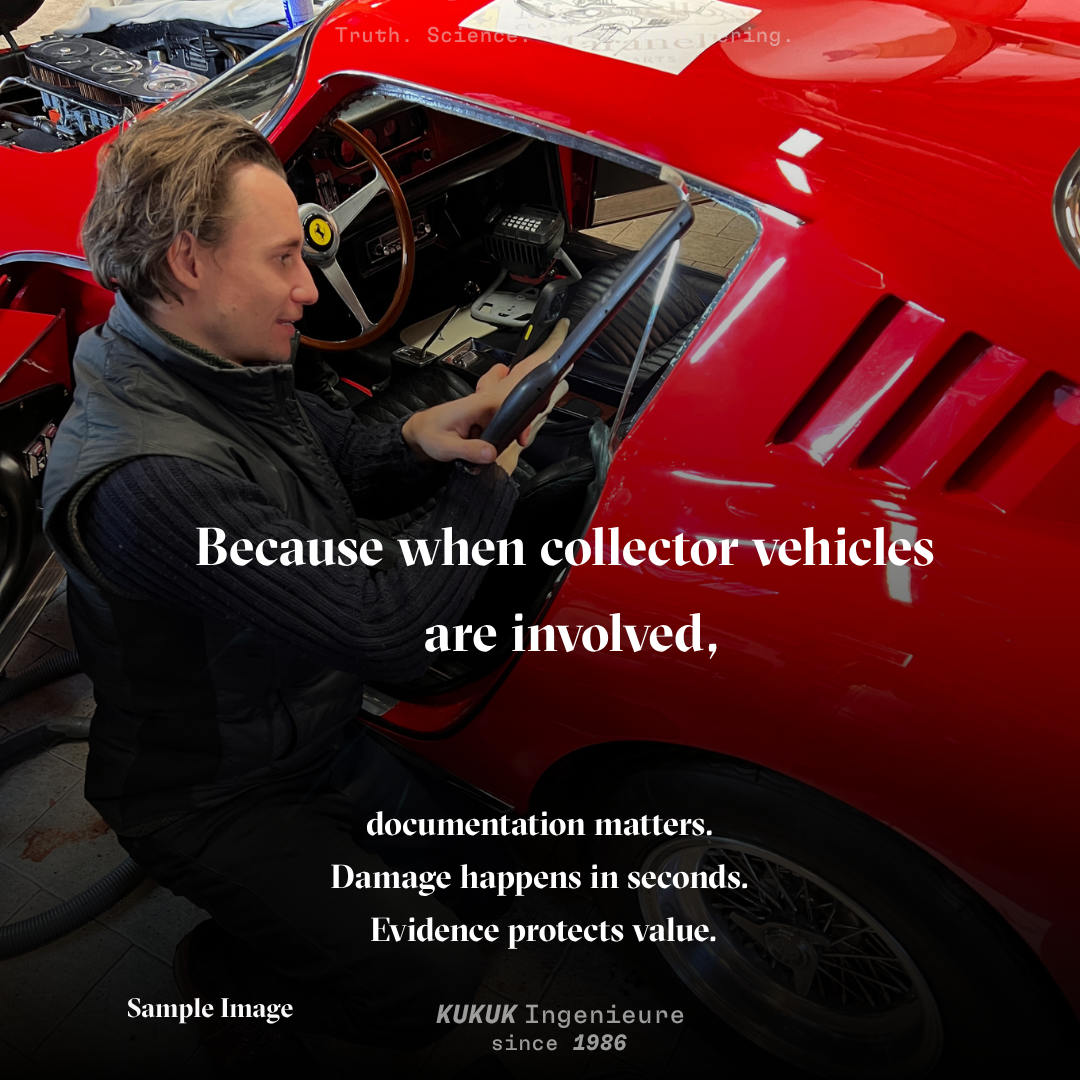
The damage occurs in seconds.The documentation decides on the value.
A precise technical analysis ensures that damages are correctly assessed and that the actual influence on the vehicle value is documented in a comprehensible manner.
From the point of view of an expert, the situation can ultimately be summarized quite simply:
The damage itself is usually immediately visible.
The decisive factor is how precisely it is documented – and which insurance structure is behind it.
Or practically formulated
The damage occurs in seconds.
Good preparation ensures that its regulation does not become the second problem.
Frequent Questions (FAQ)
How is the loss in value of a collector vehicle determined?
The loss in value is determined by a technical assessment, market analysis and documentation of the damage. Factors such as originality, repair quality and history play a major role.
Why is detailed documentation important?
Precise documentation serves as the basis for insurance claims, legal clarifications and later vehicle evaluations.
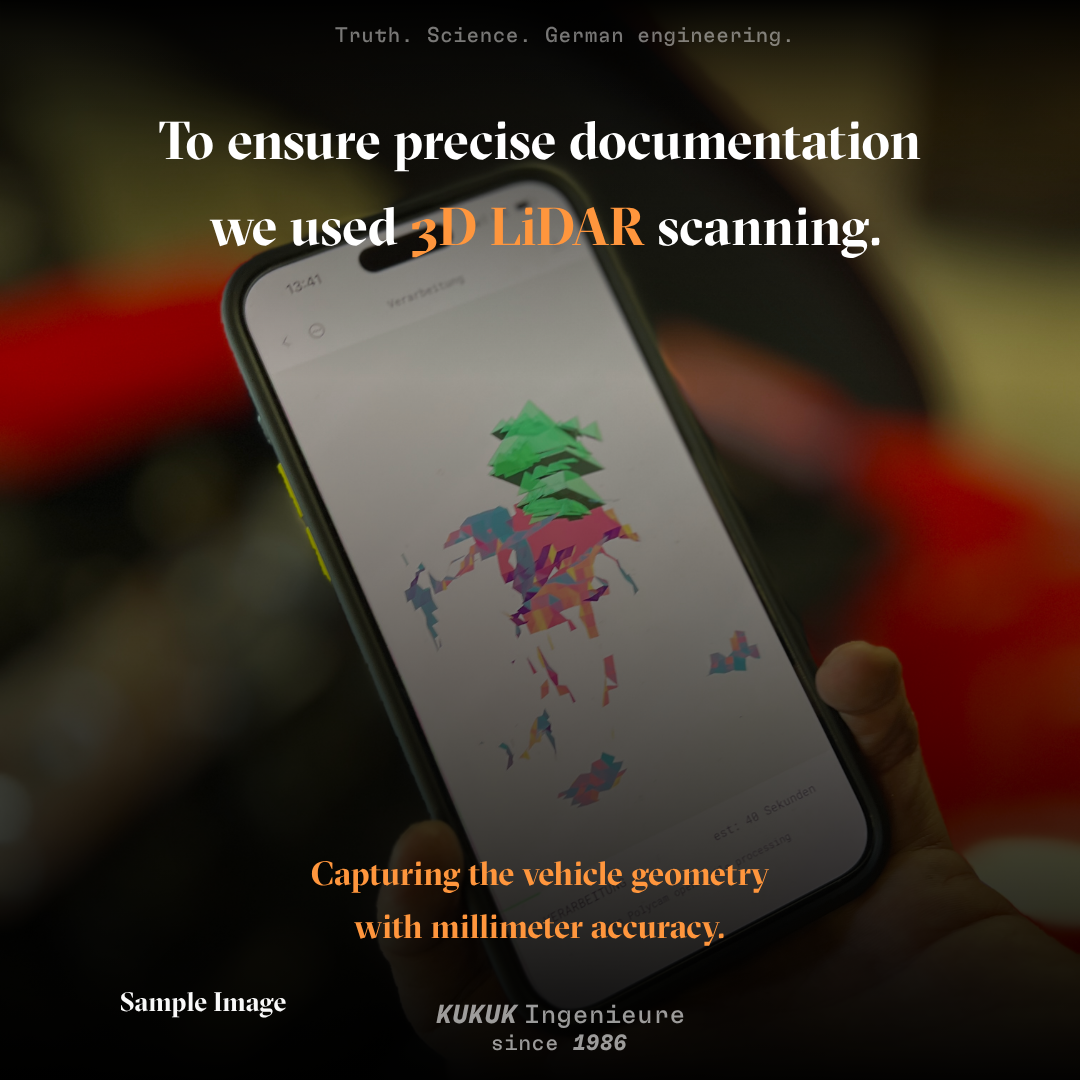
What role does 3D scanning play in the assessment?
3D scanning enables a millimeter-accurate analysis of the vehicle structure and helps to make even the smallest deformations visible.
Conclusion
The insurance structure along a transport or service process is often more complex than it appears at first glance.
Which insurance ultimately pays depends on
Who caused the damage
In which area of responsibility it was created
Vehicle owners cannot directly influence the insurance contracts of workshops, dealers or transport companies. Nevertheless, they can provide transparency in advance by following a few simple steps:
Obtain confirmation of insurance cover and coverage amounts
Clarify who actually performs the transport
Document the condition of the vehicle at handover
In the event of damage, consult an independent car expert
SEO package
SEO Title
When vehicles travel and something goes wrong: insurance and liability for collector vehicles
Meta Title
Insurance & Liability in Vehicle Transport | KUKUK Ingenieure
Insurance Liability Vehicle Transport Collector Vehicles
Focus on keywords
Vehicle transport insurance
Liability collector's vehicle
Impairment of classic cars
Car expert
Vehicle damage transport
Loss of use collector vehicle
Vehicle inspection insurance
Transport insurance for vintage cars
KUKUK Ingenieure
Vehicle documentation
Excerpt
In the event of damage to high-quality collector vehicles, the question quickly arises: Which insurance is responsible? KUKUK declares liability, documentation, impairment and technical assessment.
CTA
Do you need an independent technical assessment after a transport or workshop damage?
KUKUK Ingenieure support owners, collectors and insurance stakeholders with well-founded damage documentation, technical analysis and traceable evaluation of high-quality vehicles.