Evidence before impression. Substance before narrative.
The following content shows how KUKUK combines technical observation, documentation and experience to make important vehicle decisions more resilient.
Case requestAuthenticity testing of classic cars and collector vehicles: why it is indispensable today
The market for classic cars and collector vehicles has changed fundamentally in recent years. Today, vehicles are traded internationally, presented digitally and often evaluated on the basis of photos, documents and online advertisements.
At the same time, the risk of wrong decisions increases.
Because high-quality presentations, professionally prepared documentation or convincing restorations do not replace technical verification. Especially with rare or high-priced vehicles, not only the first impression decides on the actual value, but the comprehensible originality and technical plausibility.
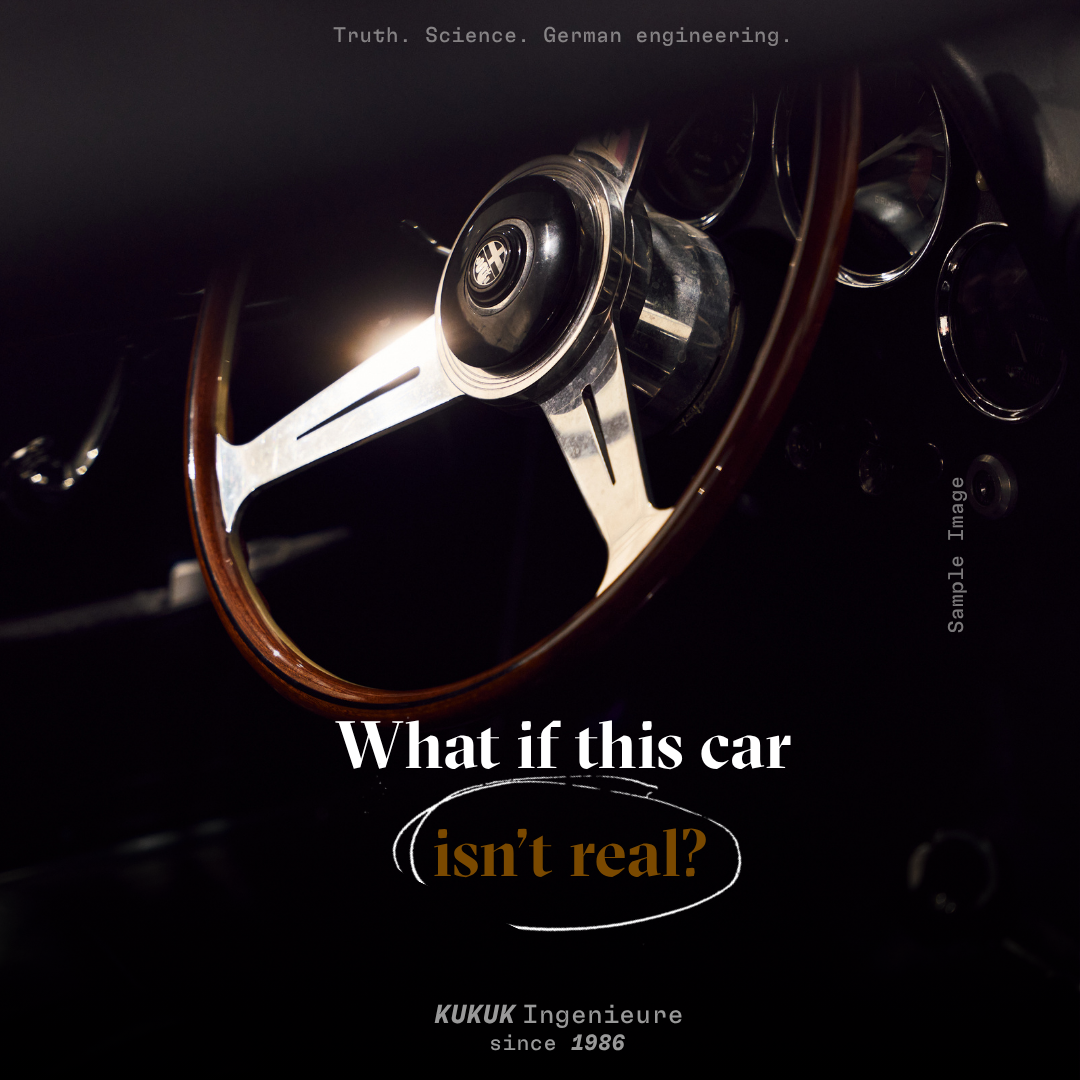


This is where the professional vehicle authenticity check starts.
It creates reliable decision-making bases for buyers, collectors, investors, insurance companies and owners – based on technical analysis, historical classification and comprehensible documentation.
What does vehicle authenticity testing mean?
The vehicle authenticity check describes the systematic technical and historical examination of a vehicle in order to evaluate originality, condition, history and plausibility.
This is not just about optical quality or complete documents.
Rather, what matters is that
Does the vehicle technically correspond to the claimed condition?
Are materials, structures and production tracks plausible in time?
Were components replaced, altered or reconstructed?
Do documentation and actual substance match?
Is the vehicle history shown reliable?
Especially with high-quality collector vehicles, small deviations can have a significant impact on market value, insurability and long-term value.
Why authenticity is so important for collectors and investors
With increasing vehicle values, the risk of expensive wrong decisions also increases.
Anyone who invests in a historical vehicle acquires not only design or emotion, but often an object with considerable financial, historical and documentary significance.
A lack of or doubtful authenticity can lead to, among other things, the following problems:
Financial losses on purchase or resale
Restricted marketability
Uncertainties in insurance or evaluation
Conflicts on estate or property issues
Long-term impairment despite good optics
This is particularly critical for vehicles with
exceptional provenance
rare production variants
historical motorsport relevance
Extensive restorations
Incomplete history
International changes of ownership
In such cases, a pure visual inspection is often not sufficient.
Impression does not equal proof
In today’s collector vehicle market, many vehicles appear convincing at first glance:
Immaculate paint
high-quality detailed shots
Professionally prepared documentation
Full invoice folder
Stylistically consistent presentations
And yet a central question remains
Which of these can actually be objectively proven?
Modern image processing, AI-supported optimization and professionally staged vehicle offers can deceive even experienced buyers today.
A vehicle can look absolutely consistent online and still:
Structural changes
Non-original components
Misdocumented restorations
Hidden later conversions
Historically implausible features show
Therefore, a professional appearance does not replace technical verification.
Why photos and documents alone are not enough
Of course, invoices, certificates, pictures and historical documents are important components of a vehicle evaluation.
However, they never show the full picture.
Crucial questions often remain open:
Was the body structure changed?
Are load-bearing areas original or replaced?
Do materials and processing correspond to the construction period?
Is the paint composition consistent with the documented history?
Were components professionally restored or only visually adapted?
Do production tracks and technical details match reference vehicles?
Especially for rare vehicles, individual implausible details can have a significant impact on classification and evaluation.
Because in the premium segment, the value depends not only on the condition, but above all on the traceable authenticity.
How professional vehicle verification works
A robust vehicle authenticity check combines technical expertise with analytical and historical procedures.
Depending on the vehicle and the question, the following tests may be relevant, inter alia:
Analysis of materials and surfaces
Examination of production traces
Coating and structural tests
Comparison with historical references
Testing of body and welding structures
Document and history comparison
Assessment of restorations and conversions
Examination of technical consistency
Analysis of assemblies and components
Digital surveying and 3D scanning
The objective is clear:
Not only to assess how a vehicle works – but to check comprehensibly what it actually is.
How Small Details Affect the Vehicle Value
In practice, it shows again and again how strongly small deviations can be significant.
A vehicle can appear externally convincing. The documentation seems plausible, the history complete and the presentation professional.
Only an in-depth technical analysis may show
subsequent structural changes
Non-contemporary materials
implausible production traces
Falsely declared restoration scopes
Replaced or reconstructed assemblies
For laymen, such differences often remain invisible.
However, they can be crucial for the evaluation.
As soon as doubts arise about originality or historical consistency, it often changes:
market perception;
Insurability
Documentation security
International tradability
long-term performance
Digital deception in the classic car market: The real risk
Today, the entry into vehicle buying usually begins digitally.
Images, videos, scans and documents create trust within seconds.
This is where the risk has grown.
Modern technologies no longer only enable the optimization of existing content. They can completely recreate content or manipulate it in a targeted manner.
These include, for example:
Artificially optimized vehicle images
Manipulated detail shots
Beautiful restoration documentation
Incompletely presented histories
Professionally staged sales stories
artificially generated time pressure
visually convincing, but technically implausible presentations
The real problem is not that information is missing.
The problem is that information can be convincing without being verifiable.
Why even experienced collectors can make wrong decisions
Digital deception is not only aimed at inexperienced buyers.
Even experienced collectors, traders or investors can make wrong decisions under time pressure, enthusiasm or apparent exclusivity.
In addition, there is a psychological factor
Anyone who has searched for a certain vehicle for a long time often wants to believe that exactly this specimen is the right one.
That is where risk arises.
Trust does not replace technical testing.
When a vehicle authenticity check is particularly useful
A professional examination is particularly useful if decisions have great financial or historical significance.
This applies, inter alia:
Before buying a high-priced classic
Before auctions or international transactions
Unclear or incomplete history
After extensive restorations
For vehicles of exceptional provenance
Before insurance or valuation issues
Suspicion of non-original substance
Disputes over state or history
The earlier critical questions are clarified, the lower the risk of later conflicts or loss of value.
What this means for the modern collector vehicle market
The market is becoming more transparent and complex at the same time.
More information is available than ever before.
At the same time, exactly this information can be professionally edited, staged or misrepresented.
Therefore, it is no longer enough for a vehicle to impress.
It must be verifiable.
Anyone who wants to collect, invest or sell sustainably needs clarity about:
Originality
Technical consistency
Quality of restoration
Documentation
Historical plausibility
Only in this way can reliable decisions be made instead of expensive assumptions.
Conclusion: Security begins where assumptions end
An extraordinary vehicle can no longer be recognized by its presentation or its history alone.
The decisive factor is whether its peculiarity also withstands a well-founded technical examination.
This is the value of professional vehicle authenticity checking.
It replaces assumptions with comprehensible findings.
Those who need clarity about originality, condition or historical consistency should not make critical decisions solely on the basis of photos or documents.
Especially in today’s collector vehicle market, more than ever
Impression is not proof.
Frequent questions about vehicle authenticity checking
How can the authenticity of a classic car be checked?
The authenticity of a vintage car is verified by technical analysis, document verification and comparison with historical references. The goal is a comprehensible evaluation of originality, history and technical consistency.
Is a visual inspection of collector vehicles sufficient?
No. Many value-relevant features are not recognizable with the naked eye or only limited. Especially structural, material-related or historical deviations are often hidden.
Why does authenticity affect the vehicle value so much?
Authenticity forms the basis for trust, market value, insurability and long-term value. The rarer and higher-quality a vehicle is, the greater this influence.
When does a professional authenticity check make sense?
It is particularly useful before high-priced purchases, auctions, restorations, international transactions or unclear history.
What role do technical analysis play in verification?
Technical analyses help to objectively evaluate materials, structures, production traces and restoration measures and compare them with historical references.